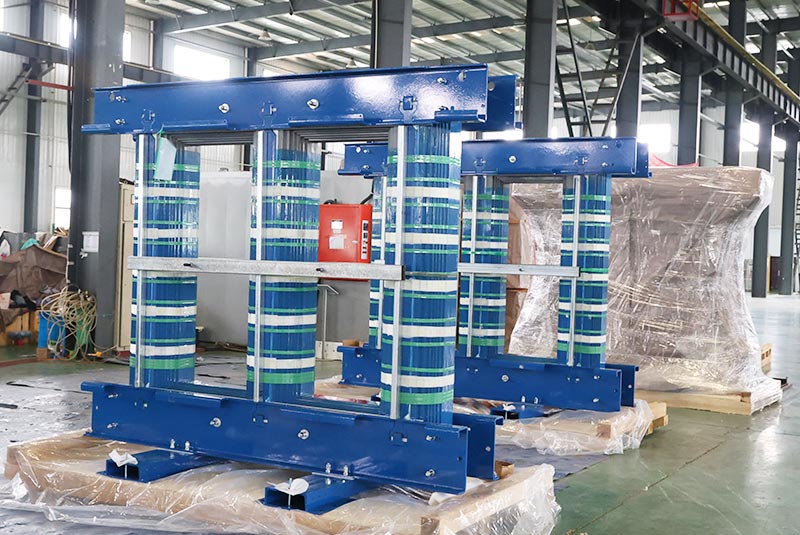
What a Laminated Transformer Core Is
A laminated transformer core is the magnetic path inside a transformer, built from many thin sheets of electrical steel rather than one solid metal block. These sheets are stacked, clamped, and arranged to guide magnetic flux between the windings with controlled losses and stable mechanical strength.
The lamination approach is widely used in distribution transformers, power transformers, control transformers, reactors, and many custom electromagnetic devices. Its main purpose is to improve magnetic performance while limiting heat generated by circulating currents inside the core material.
Why Laminations Are Used
When alternating current flows through a transformer winding, the magnetic field in the core changes continuously. If the core were made from one solid conductive piece, this changing field would induce larger eddy currents. These currents waste energy and raise the operating temperature.
Thin laminations reduce the path available for eddy currents. Each sheet is insulated from the next by a surface coating, so current loops are restricted and core loss is reduced. This helps the transformer operate more efficiently and supports longer service life.
Common Materials and Construction
Most laminated cores use cold-rolled grain-oriented or non-grain-oriented silicon steel. Grain-oriented steel is preferred where magnetic flux mainly follows one direction, while non-grain-oriented steel can be useful in applications with more varied flux paths.
Typical construction methods include EI laminations, UI laminations, step-lap cores, and mitered core joints. The choice depends on the transformer rating, voltage class, efficiency target, noise requirements, and production method.
Key Advantages
A well-made laminated transformer core can provide lower no-load loss, stable magnetizing performance, and predictable thermal behavior. It also allows manufacturers to adjust core size, stack height, and joint design according to the electrical specification.
- Reduced eddy current loss compared with solid cores
- Good dimensional flexibility for different transformer designs
- Mature manufacturing process and wide material availability
- Suitable for many low-voltage and medium-voltage applications
Selection Considerations
When evaluating a laminated transformer core, buyers should review steel grade, thickness, burr control, stacking factor, dimensional tolerance, coating quality, and clamping structure. Even small inconsistencies in cutting or assembly can affect noise, heat, and efficiency.
For export projects, it is also useful to confirm whether the supplier can provide test records, material certificates, drawing review, packaging suitable for sea transport, and production traceability.