Purpose of Transformer Insulation
Transformer insulation materials separate conductive parts, control electric stress, and protect the active part from thermal and mechanical damage. They are essential to transformer reliability because insulation aging is one of the main factors that limits service life.
A complete insulation system may include solid insulation, liquid insulation, spacers, barriers, tapes, tubes, and molded parts. These materials must work together under voltage, heat, oil exposure, and short-circuit forces.
Common Solid Insulation Materials
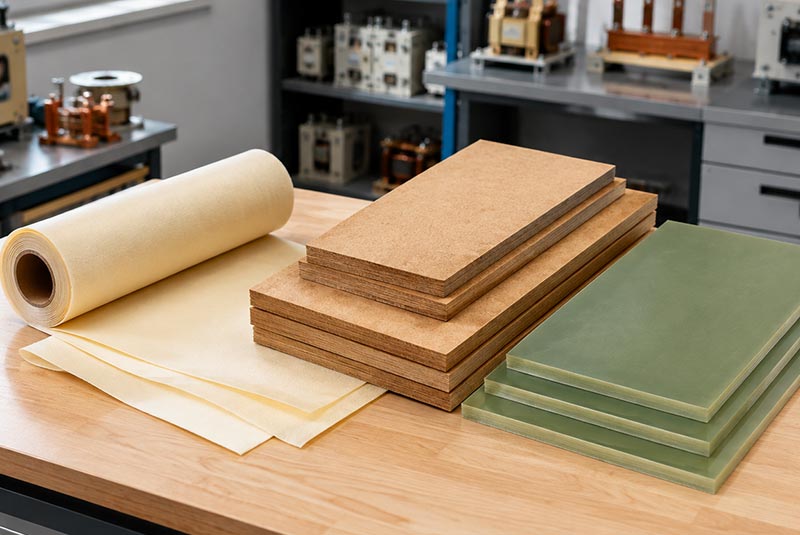
Cellulose-based insulation is widely used in oil-immersed transformers. Kraft paper, crepe paper, pressboard, and laminated wood are common because they combine electrical strength, oil compatibility, and processability.
In dry-type transformers and special applications, materials such as Nomex paper, fiberglass, epoxy resin, polyester film, and mica products may be used depending on temperature class and voltage requirement.
Liquid and Composite Insulation
Mineral oil is still widely used as both an insulating and cooling medium. Natural ester and synthetic ester fluids are also used where fire safety, environmental performance, or moisture tolerance is important.
The performance of liquid insulation depends on dielectric strength, moisture content, acidity, oxidation stability, and compatibility with gaskets and solid materials.
Key Selection Criteria
Insulation material selection should match transformer voltage, temperature class, impulse requirement, expected lifetime, cooling method, and applicable standards. Good material alone is not enough; drying, impregnation, handling, and storage also affect final performance.
- Dielectric strength and partial-discharge resistance
- Thermal class and aging behavior
- Oil or resin compatibility
- Mechanical strength under winding pressure
- Moisture control during storage and assembly
Supplier Evaluation
Buyers should ask for material data sheets, test reports, batch traceability, storage recommendations, and dimensional tolerances. For customized insulation parts, drawing review and sample approval are important before mass production.
A reliable insulation supplier should understand both material properties and transformer manufacturing conditions. This helps avoid mismatches that may only appear during drying, assembly, or electrical testing.